
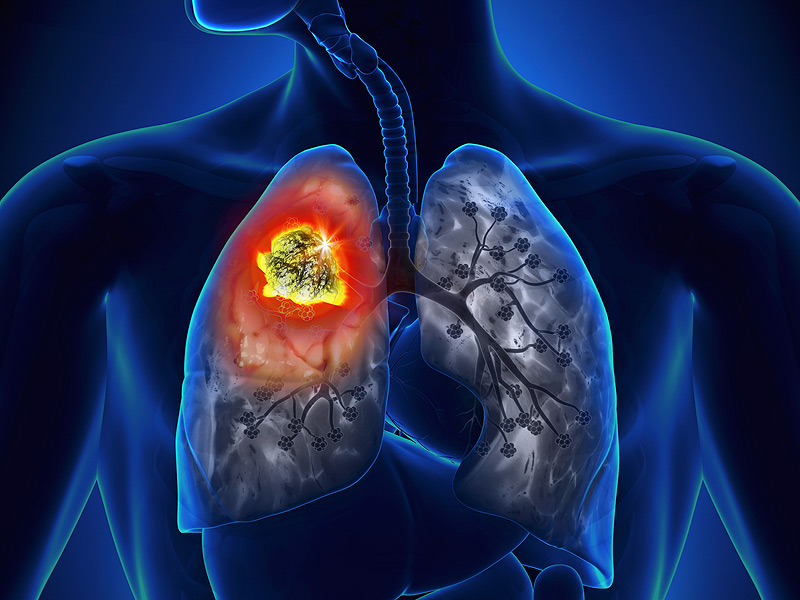
lung_cancer.jpg
13/Feb/2026

On March 18, 2019, the Food and Drug Administration approved atezolizumab (TECENTRIQ, Genentech Inc.) in combination with carboplatin and etoposide, for the first-line treatment of adult patients with extensive-stage small cell lung cancer (ES-SCLC).

Approval was based on IMpower133 (NCT02763579), a randomized (1:1), multicenter, double-blind, placebo-controlled trial in 403 patients with ES-SCLC who received no prior chemotherapy for extensive stage disease and had ECOG performance status 0 or 1. Patients were randomized to one of the following:

  • atezolizumab 1200 mg and carboplatin AUC 5 mg/mL/min on day 1 and etoposide 100 mg/m2 intravenously on days 1, 2 and 3 of each 21-day cycle for a maximum of 4 cycles, followed by atezolizumab 1200 mg once every 3 weeks until disease progression or unacceptable toxicity, or
  • placebo and carboplatin AUC 5 mg/mL/min on day 1 and etoposide 100 mg/m2 intravenously on days 1, 2, and 3 of each 21-day cycle for a maximum of 4 cycles, followed by placebo once every 3 weeks until disease progression or unacceptable toxicity.

Major efficacy outcome measures were overall survival (OS) and progression-free survival (PFS) as assessed by investigator per RECIST 1.1 in the intent-to-treat population. Median OS was 12.3 months (10.8, 15.9) for patients receiving atezolizumab with chemotherapy and 10.3 months (9.3, 11.3) for those
receiving placebo with chemotherapy (hazard ratio 0.70; 95% CI: 0.54, 0.91; p=0.0069). Median PFS was 5.2 months (4.4, 5.6) compared with 4.3 months (4.2, 4.5) in the atezolizumab and placebo arms, respectively (HR 0.77; 0.62, 0.96; p=0.0170).

The most common adverse reactions reported in ≥ 20% of patients who received atezolizumab in IMpower133 were fatigue/asthenia, nausea, alopecia, constipation, and decreased appetite.

The recommended atezolizumab dose for patients with ES-SCLC is 1200 mg intravenously over 60 minutes every 3 weeks. When administered on the same day, atezolizumab should be administered prior to chemotherapy. If the first infusion is tolerated, all subsequent infusions may be delivered over 30 minutes.


Chemotherapy.jpg
13/Feb/2026

On December 6, 2018, the Food and Drug Administration approved atezolizumab (TECENTRIQ, Genentech, Inc.), in combination with bevacizumab, paclitaxel, and carboplatin for the first-line treatment of patients with metastatic non-squamous, non-small cell lung cancer (NSq NSCLC) with no EGFR or ALK genomic tumor aberrations.

Approval was based on the IMpower150 trial (NCT02366143), an open-label, randomized (1:1:1), three-arm trial enrolling 1202 patients receiving first-line treatment for metastatic NSq NSCLC. Eighty-seven percent (1045 patients) were identified as not having EGFR or ALK tumor mutations. The trial was designed to conduct comparisons between each of the atezolizumab-containing arms with the control arm. Patients were randomized to receive the following:

  • Atezolizumab, carboplatin, paclitaxel, and bevacizumab (4-drug regimen);
  • Atezolizumab, carboplatin and paclitaxel (3-drug regimen); or
  • Carboplatin, paclitaxel, and bevacizumab (control arm).

Following completion of 4 or 6 cycles of carboplatin and paclitaxel, patients continued to receive bevacizumab in the 4-drug arm and the control arm and continued to receive atezolizumab in the two experimental arms until disease progression or unacceptable toxicity. The major efficacy measures were overall survival (OS) and progression-free survival (PFS).

Among patients with NSq NSCLC without an EGFR or ALK mutation, the estimated median OS was 19.2 months for patients receiving the 4-drug regimen and 14.7 months for those receiving, carboplatin, paclitaxel, and bevacizumab (hazard ratio [HR] 0.78; 95% CI: 0.64, 0.96; p=0.016). The estimated median PFS was 8.5 months for patients receiving the 4-drug regimen and 7.0 months for those in the control arm (HR 0.71; 95% CI 0.59, 0.85; p=0.0002). The overall response rates were 55% in the 4-drug arm and 42% in the control arm. No significant differences in interim OS or final PFS were observed between the 3-drug arm and the control arm.

The most common adverse reactions (reported in ≥ 20% of patients) with atezolizumab administered with carboplatin, paclitaxel, and bevacizumab were fatigue/asthenia, alopecia, nausea, diarrhea, constipation, decreased appetite, arthralgia, hypertension, and neuropathy. Atezolizumab was discontinued for adverse reactions in 15% of patients; the most common adverse reaction resulting in discontinuation of atezolizumab was pneumonitis (1.8%).

The incidence of development antibodies to atezolizumab (anti-drug antibodies, ADA) ranges from 30% to 42% across clinical studies supporting the approved indications. Among 364 patients with NSCLC who received the 4-drug regimen in the IMpower150 study, 36% (n=132) had treatment-emergent antibodies against atezolizumab with the majority (83% of these 132 patients) having ADA prior to receiving the second atezolizumab dose. Patients who tested positive for treatment-emergent ADA had lower systemic atezolizumab exposure compared to those who were ADA negative. In an exploratory analysis, the HR for OS was similar in the ADA-positive (0.69; 95% CI: 0.44, 1.07) and the ADA-negative subgroups (0.64; 95% CI: 0.46, 0.90). The presence of ADA neither increased the incidence nor severity of adverse reactions. Given the high rate of ADA, Genentech has agreed to conduct analyses across the atezolizumab development program to evaluate the effects of ADA on efficacy, safety, and pharmacokinetics.

The recommended atezolizumab dose is 1200 mg intravenously over 60 minutes every 3 weeks.


Who are we

Providing cancer care for all patients. At Houston Cancer Treatment Centers providers are offering cutting edge cancer and hematology treatment for the patients in your neighborhood.

Contact Details

PASADENA CLINIC

4102 Woodlawn Ave Suite 160
Pasadena – TX – 77504
+(832) 879-2942


CLEARLAKE / SOUTH EAST HOUSTON

11914 Astoria Suite 480
Houston, TX 77089
+(832) 879-2942

© 2026 Houston Cancer Treatment Centers. Powered by MeshTech Solutions